

内容
# Agentic Android Open Source Project (AAOSP)
**MCP + on-device LLM on Android 15 — built before Android 16 shipped its own MCP-equivalent.**
An AOSP fork for Android 15 where apps declare MCP tools in their manifest, a local LLM runs as a system service that discovers and invokes those tools, and every call is consent-gated and audit-logged at the platform tier. Apache 2.0, on-device, no Google dependency.
MCP (Model Context Protocol) is the standard. Every major AI platform — Claude, GPT, Gemini — speaks it. Every tool, every integration, every workflow is converging on MCP as the universal interface between AI and software. Android has always been a platform built on protocols: Intents, Content Providers, Broadcast Receivers were the right abstractions for the app era. MCP is the right abstraction for the agentic era.
AAOSP brought that to Android 15 end-to-end: a `<mcp-server>` manifest schema, `LlmManagerService` (Qwen 2.5 via llama.cpp inside `system_server`), platform-level HITL consent + audit, a reference launcher, and two reference MCP apps. Stock Android 15 had no comparable primitive. Android 16 later shipped App Functions (`@AppFunction` + `AppFunctionManager`) as its own cross-app tool-invocation layer — convergent evidence that the primitive belongs at the platform tier. AAOSP predates that and stays on Android 15 as the reference implementation of the MCP-native pattern.
**Apps declare tools. The OS runs the model. The user approves every write.** No Google license, no closed model, no orchestrator you don't control.
[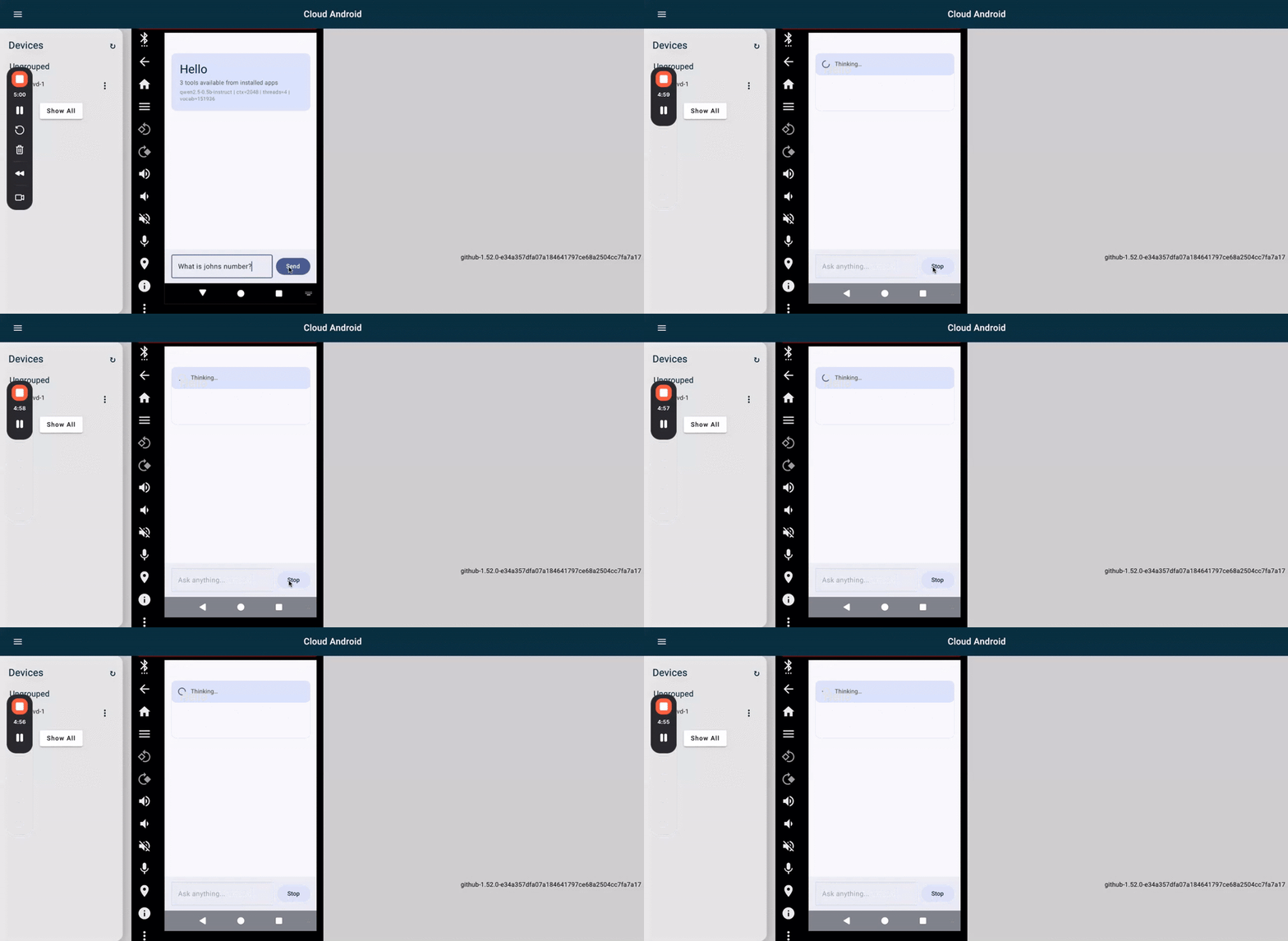](https://www.loom.com/share/7493fe15dee9463c9626c170e1e44e92)
*The thumbnail above is a GIF of the first few seconds — **click through to watch the full demo.** Qwen 2.5 emits a `<tool_call>` for `search_contacts`, AAOSP dispatches to `ContactsMcp` via `IMcpToolProvider.invokeTool()`, the result round-trips through a second LLM pass, and the answer renders in the chat UI with an attribution card showing the Contacts app icon. Recorded on v0.3; a refreshed v0.6 demo with 3B + cross-MCP chaining + HITL write flow is queued.*
**Current release: `v0.5`** (2026-04-14). Ships the agentic loop with
per-tool HITL consent, audit log, and cross-MCP chaining across **two**
reference MCPs: `ContactsMcp` (contacts read + write) and `CalendarMcp`
(calendar read + write). Default model is now **Qwen 2.5 3B** — the 0.5B
demo above was pattern-matching; 3B actually reasons about tool choice.
See [`docs/CHANGELOG.md`](docs/CHANGELOG.md) for the full v0.5 delta,
[`docs/ROADMAP.md`](docs/ROADMAP.md) for what's next, and
[`docs/DESIGN_NOTES.md`](docs/DESIGN_NOTES.md) for parked designs
(third-party MCP trust model, provider-contributed examples).
> **⭐ If the demo above made you nod, [star the repo](https://github.com/rufolangus/AAOSP).** It's the cheapest way to signal which AOSP forks are worth tracking and helps the right contributors find this.
## What This Is
An AOSP fork (Android 15) that adds three platform-tier things plus a reference app:
1. **An LLM that runs as a system service** — like LocationManager or NotificationManager, but for intelligence. Local inference via llama.cpp inside `system_server`. No cloud, no API keys, no data leaving the device. Qwen 2.5 by default; any llama.cpp-compatible GGUF works.
2. **MCP in the manifest** — apps declare their capabilities as MCP tools in `AndroidManifest.xml`, the same way they've always declared intents and permissions. The platform indexes them at install time; the LLM discovers and calls them at runtime.
3. **HITL consent + audit as a platform feature** — per-app consent, per-call confirmation on write-intent tools, persistent audit log. Not a library, not an app concern — a platform invariant every MCP call flows through.
Plus **AgenticLauncher** — a reference role-holder that renders the agent loop as chat, inline tool-call cards, and a server-driven UI surface. Not the only possible orchestrator; a demonstration of one.
## Why
Every phone has a dozen apps that each do one thing. To send a message, you open the messaging app. To check a calendar event, you open the calendar app. To find a contact, you open the contacts app.
An agent just does it. "Text John I'll be late, and move my 3pm meeting to 4" — one sentence, two apps, zero app switching.
Android already has the pieces. Binder IPC is the fastest inter-process communication on mobile. PackageManager already indexes app capabilities at install time. The manifest already declares what apps can do. AAOSP connects these pieces to an LLM through MCP — the protocol the entire AI industry is standardizing on.
This isn't adding AI to Android. This is Android adapting to the world that already exists.
## Where this fits
AAOSP is a reference project — a working demonstration that MCP-style tool declaration belongs at the platform tier, alongside intents and permissions, not as an SDK bolted on top.
On Android 15 there was no cross-app agent substrate: no tool-declaration schema, no on-device LLM runtime, no platform-level consent or audit for agent-driven calls. AAOSP built one end-to-end — `<mcp-server>` in manifests, `LlmManagerService` in `system_server`, HITL consent + audit, reference launcher and MCP apps — on Android 15 Cuttlefish.
Android 16 later shipped App Functions (`@AppFunction` + `AppFunctionManager`) as its own cross-app tool-invocation layer. Google's own docs call it *"the mobile equivalent of tools within the Model Context Protocol (MCP)."* That's convergent evidence — the primitive belongs at the platform tier. AAOSP predates that and stays on Android 15 as the reference artifact. It does not compete with App Functions, does not migrate to Android 16, and does not attempt to be a production runtime for newer devices.
The next step in this lineage on Android 16 is [**JibarOS**](https://github.com/Jibar-OS/JibarOS) — same conviction (on-device AI belongs at the platform tier), broader scope. Where AAOSP's `LlmManagerService` is one llama.cpp LLM purpose-built for MCP tool-calling, JibarOS's Open Intelligence Runtime is twelve capabilities (text / audio / vision) across four backends (llama.cpp, whisper.cpp, ONNX Runtime, libmtmd) with pooled residency, KV-budgeted memory, and a cross-backend priority scheduler. An MCP-native agent — including AAOSP's exact pattern — could sit on top of JibarOS and use it as the inference substrate. Complementary, not competitive. AAOSP stays on Android 15 as the MCP-native reference artifact; JibarOS picks up the runtime layer on Android 16.
### What's Apache 2.0 in AAOSP
- `<mcp-server>` manifest schema + `McpManifestParser` + `McpRegistry` (the tool-declaration layer).
- `LlmManagerService` — on-device inference via llama.cpp inside `system_server`; model-agnostic.
- `HitlConsentStore` + `ConsentGate` — platform-level HITL consent and audit.
- AgenticLauncher, ContactsMcp, CalendarMcp — reference launcher and MCP apps.
- Model weights: Qwen 2.5 (third-party Apache 2.0); runtime is model-agnostic.
## What AAOSP won't do
Positioning is also what you refuse. AAOSP will not:
- **Phone home.** No telemetry to AAOSP, no telemetry to anyone. Inference, tool calls, and audit logs stay on the device.
- **Require a model license.** The runtime is model-agnostic — Qwen today, swap to Llama, Mistral, Gemma, anything llama.cpp can load. No exclusivity, no per-device fee.
- **Put a third party between the user and their apps.** No closed orchestrator decides which app answers a user's request. The launcher does. The user does. The orchestrator is user-replaceable, same as a default launcher or default browser.
- **Gate apps behind an allowlist.** Any app with `<mcp-server>` in its manifest is reachable. No SDK, no review queue, no developer program.
## Who this is for
AAOSP is a reference / research artifact, not a product. It's for people who want to see MCP-native Android running end-to-end and reason about what that shape implies:
- **Android-platform folks** curious how tool declaration, agent loops, and platform-level HITL could fit inside `system_server` — AAOSP is a working implementation you can boot, inspect, and modify.
- **App developers** who want to see what MCP in a manifest actually looks like — declare `<mcp-server>`, implement one AIDL, and your app is reachable by a local agent. No SDK, no per-vendor integration.
- **On-device-AI researchers and the open-model community** looking for an Apache-2.0 AOSP fork that runs an end-to-end agent loop with consent and audit on real model weights (Qwen 2.5, swappable).
- **Anyone thinking about "what should Android's agentic layer look like?"** — AAOSP is one answer, shipped in code on Android 15.
## Architecture
```
+----------------------------------------------+
| Agentic Launcher |
| (Compose, server-driven UI) |
+-----------------------+----------------------+
| Binder (SUBMIT_LLM_REQUEST)
+-----------------------v----------------------+
| LLM System Service |
| +------------+ +------------------------+ |
| | Qwen 2.5 | | MCP Tool Registry | |
| | (llama.cpp)| | (indexed from manifests)| |
| +------------+ +------------------------+ |
| +------------+ +------------------------+ |
| | Session | | Tool Stats | |
| | Store (DB) | | (reliability tracking) | |
| +------------+ +------------------------+ |
+------+-------------+-------------+-----------+
| Binder | Binder | Binder
| (BIND_LLM_ | (BIND_LLM_ | (BIND_LLM_
| MCP_SERVICE) | MCP_SERVICE)| MCP_SERVICE)
+------v------+ +-----v------+ +---v----------+
| Contacts | | Messaging | | Calendar |
| <mcp-server>| | <mcp-server>| | <mcp-server> |
| tools: | | tools: | | tools: |
| search | | send_sms | | get_events |
| get_contact| | read_msgs | | create_event|
+-------------+ +-------------+ +--------------+
```
## How Apps Become Agentic
Any app can become an MCP server. Add two blocks to your manifest, implement one AIDL interface, done. Full working reference: **[packages/apps/ContactsMcp](https://github.com/rufolangus/platform_packages_apps_ContactsMcp)**.
### 1. Declare tools in your manifest
You need **both** an Android `<service>` (the binder endpoint the OS binds to) **and** an `<mcp-server>` (the metadata the registry parses). The example below is lifted verbatim from the reference `ContactsMcp` app.
```xml
<manifest xmlns:android="http://schemas.android.com/apk/res/android"
package="com.android.contacts.mcp"
android:versionCode="102"
android:versionName="1.0.2">
<uses-permission android:name="android.permission.READ_CONTACTS" />
<application android:label="@string/app_name">
<service
android:name=".ContactsMcpService"
android:permission="android.permission.BIND_LLM_MCP_SERVICE"
android:exported="true">
<intent-filter>
<action android:name="android.llm.MCP_SERVICE" />
</intent-filter>
</service>
<mcp-server
android:name=".ContactsMcpService"
android:description="@string/mcp_description"
android:permission="android.permission.BIND_LLM_MCP_SERVICE">
<tool android:name="search_contacts"
android:description="@string/tool_search_desc">
<input android:name="query"
android:description="@string/input_query_desc" />
</tool>
<tool android:name="get_contact"
android:description="@string/tool_get_desc">
<input android:name="name"
android:description="@string/input_name_desc" />
</tool>
<tool android:name="list_favorites"
android:description="@string/tool_favorites_desc" />
</mcp-server>
</application>
</manifest>
```
> **Gotcha (Android 15):** the `<intent-filter>` on the `<service>` is **required**, even if your service is only bound by component name. PMS silently drops `<service>` declarations without one. Use any no-op action — `android.llm.MCP_SERVICE` is the convention.
### 1b. Full schema
The parser in `frameworks/base/services/core/java/com/android/server/pm/McpManifestParser.java` accepts more than ContactsMcp uses. Here's everything framework-base reads into `McpRegistry` today, shown on a hypothetical `MessagingMcp`:
```xml
<mcp-server
android:name=".MessagingMcpService"
android:description="@string/mcp_description"
android:permission="android.permission.BIND_LLM_MCP_SERVICE"
android:mcpVersion="2024-11-05">
<!-- Destructive tool with per-tool permission override and typed,
required inputs. -->
<tool android:name="send_message"
android:description="@string/tool_send_desc"
android:permission="android.permission.SEND_SMS"
android:mcpRequiresConfirmation="true">
<input android:name="recipient"
android:description="@string/input_recipient_desc"
android:mcpType="string"
android:mcpRequired="true" />
<input android:name="body"
android:description="@string/input_body_desc"
android:mcpType="string"
android:mcpRequired="true" />
<input android:name="priority"
android:description="@string/input_priority_desc"
android:mcpType="string"
android:mcpEnumValues="low,normal,high" />
</tool>
<!-- Read-only tool with a typed-integer input. -->
<tool android:name="get_recent"
android:description="@string/tool_recent_desc">
<input android:name="count"
android:description="@string/input_count_desc"
android:mcpType="integer"
android:mcpRequired="false" />
</tool>
<!-- Resource the LLM can read or list via IMcpToolProvider.
Surfaces as a typed content:// URI the system can hand back. -->
<resource android:name="recent_messages"
android:description="@string/resource_recent_desc"
android:mcpUri="content://com.example.messaging/recent"
android:mimeType="application/json" />
</mcp-server>
```
### Support matrix (v0.5)
| Element / attribute | Parsed into `McpRegistry` | Used in the runtime today |
|---|---|---|
| `<mcp-server>` `name` / `description` / `permission` | ✅ | ✅ (binder gating, prompt injection) |
| `<mcp-server>` `mcpVersion` | ✅ → `McpServerInfo.protocolVersion` | ⚠️ stored, not consumed |
| `<tool>` `name` / `description` | ✅ | ✅ (listed in `<tools>` prompt block) |
| `<tool>` `permission` (per-tool override) | ✅ → `McpToolInfo.permission` | ⚠️ stored, not enforced |
| `<tool>` `mcpRequiresConfirmation` | ✅ → `McpToolInfo.requiresConfirmation` | ⚠️ stored; HITL consent UI is designed, not wired |
| `<input>` `name` / `description` | ✅ | ✅ |
| `<input>` `mcpType` (`string` / `number` / `integer` / `boolean` / `array` / `object`) | ✅ → `McpInputInfo.type` | ⚠️ flattened to `"string"` in the current prompt builder |
| `<input>` `mcpRequired` | ✅ | ✅ (feeds the `required` array of the tool's JSON schema) |
| `<input>` `mcpEnumValues` (comma-separated) | ✅ → `McpInputInfo.enumValues` | ⚠️ stored, not surfaced in the prompt yet |
| `<resource>` `name` / `mcpUri` / `description` / `mimeType` | ✅ → `McpResourceInfo` | ⚠️ stored, not exposed to the LLM (no resources block in the prompt yet) |
### 2. Implement the AIDL interface
```java
package com.android.contacts.mcp;
import android.app.Service;
import android.content.Intent;
import android.llm.IMcpToolProvider;
import android.os.IBinder;
import org.json.JSONObject;
public class ContactsMcpService extends Service {
private final IMcpToolProvider.Stub mBinder = new IMcpToolProvider.Stub() {
@Override
public String invokeTool(String toolName, String argumentsJson) {
try {
JSONObject args = new JSONObject(argumentsJson);
switch (toolName) {
case "search_contacts":
return searchContacts(args.optString("query"));
case "get_contact":
return getContact(args.optString("name"));
case "list_favorites":
return listFavorites();
default:
return "{\"error\":\"unknown tool: " + toolName + "\"}";
}
} catch (Exception e) {
return "{\"error\":\"" + e.getMessage() + "\"}";
}
}
@Override
public String readResource(String resourceName) {
return "{}"; // not used in this app
}
@Override
public String listResources(String uriPattern) {
return "[]"; // not used in this app
}
};
@Override
public IBinder onBind(Intent intent) { return mBinder; }
// searchContacts, getContact, listFavorites each return a JSON string.
// See ContactsMcpService.java for the ContactsContract queries.
}
```
`IMcpToolProvider` lives at `frameworks/base/core/java/android/llm/IMcpToolProvider.aidl` — three methods, all returning `String` (JSON payload is the contract):
```aidl
interface IMcpToolProvider {
String invokeTool(String toolName, String argumentsJson);
String readResource(String resourceName);
String listResources(String uriPattern);
}
```
### 3. That's it
The OS handles everything else (status of each piece as of `v0.5`):
- **Discovery** ✅ — `LlmManagerService.discoverMcpServices()` runs at `PHASE_BOOT_COMPLETED`, reads every installed app's manifest, and registers `<mcp-server>` entries into `McpRegistry`.
- **Prompt injection** ✅ — every registered tool is serialized into Qwen's `<tools>…</tools>` chat template block on each inference call.
- **Routing** ✅ — when the LLM emits `<tool_call>{"name":…,"arguments":…}</tool_call>`, the dispatcher looks up the owning package/service from the routing table and binds to it via `IMcpToolProvider`.
- **Execution** ✅ — binder call to `invokeTool()` with a 60s timeout (bumped from 10s in v0.5.1 to match `CONSENT_TIMEOUT_MS`); the JSON result feeds a second LLM pass for natural-language presentation, except when the tool returned `"error":"needs_permission"`, in which case the chain short-circuits (v0.5.1) and the launcher's `PermissionRequiredCard` is the final chat element.
- **Consent / confirmation / audit** ✅ shipped in v0.5 (`HitlConsentStore` + `ConsentGate` + `ConsentPromptCard` + SQLite audit trail). `mcpRequiresConfirmation="true"` on a `<tool>` gates the call behind a 4-button prompt (Once / This chat / Always / Deny); `SCOPE_FOREVER` is silently downgraded to `SESSION` for write-intent tools.
- **Reliability stats** ⚠️ scaffolded (`LlmSessionStore`), not yet wired. Future: the system tracks per-tool success rates and deprioritizes unreliable tools.
## The Model
AAOSP ships with **Qwen 2.5**, auto-selected by device capability:
| Device RAM | Model | Disk | Why |
|---|---|---|---|
| 12GB+ | Qwen 2.5 7B Q4_K_M | ~4.4 GB | Best tool-calling accuracy |
| **8GB+** | **Qwen 2.5 3B Q4_K_M** | **~2.0 GB** | **Default — best balance** |
| 4-8GB | Qwen 2.5 1.5B Q4_K_M | ~1.1 GB | Faster, lighter |
| <4GB | Qwen 2.5 0.5B Q8_0 | ~0.5 GB | Basic capability |
Runs entirely on-device via llama.cpp. No network required. Only hardware verified in-tree so far is Cuttlefish x86_64 (silvermont) on cloud-build CPU — see `docs/ROADMAP.md` for measured numbers. Phone-class performance will be benchmarked once we have a physical target.
Qwen 2.5 was chosen for its structured output reliability — it consistently generates valid JSON tool calls, which is critical for MCP.
## Permission Model
Apps are tools, not clients. They never talk to the LLM — the LLM talks to them.
| Permission | Level | Who | Purpose |
|---|---|---|---|
| `SUBMIT_LLM_REQUEST` | signature\|privileged | Launcher, SystemUI | Submit prompts, receive responses |
| `BIND_LLM_MCP_SERVICE` | signature | system_server | Bind to app MCP services |
| *(none)* | — | All other apps | Declare `<mcp-server>`, implement AIDL |
Third-party apps cannot submit arbitrary prompts to the LLM. They can only offer tools and wait to be called. This prevents abuse and keeps the user in control through the launcher.
## Human in the Loop
The user is always in control. Three layers of consent, from coarse to fine:
### Layer 1: MCP Server Access (first-use, per-app)
The first time the LLM wants to use any tool from an app, the system shows a consent dialog:
```
┌──────────────────────────────────────┐
│ Allow AI to use Contacts? │
│ │
│ This app's AI tools: │
│ * Search contacts │
│ * Get contact details │
│ * List favorites │
│ │
│ You can change this anytime in │
│ Settings -> AI -> Tool Access. │
│ │
│ [Don't Allow] [Allow] │
└──────────────────────────────────────┘
```
The decision is persisted and revocable in Settings. Same pattern as Android runtime permissions.
### Layer 2: Action Confirmation (per-call, destructive tools)
Tools with `mcpRequiresConfirmation="true"` show what will happen before it happens:
```
┌──────────────────────────────────────┐
│ Send message? │
│ │
│ To: John Smith │
│ Message: "Running late, be there │
│ in 20 min" │
│ │
│ [ ] Don't ask again for this action │
│ │
│ [Cancel] [Send] │
└──────────────────────────────────────┘
```
The "Don't ask again" checkbox lets the user auto-confirm tools they trust. Auto-confirms are per-tool, per-user, and revocable in Settings. Revoking server access (Layer 1) also clears all auto-confirms for that app.
### Layer 3: Audit Trail (passive, always on)
Every tool call is logged: what tool, what arguments, what result, whether confirmation was required/auto-confirmed, success or failure, latency. Users can review this in Settings under AI activity. Capped at 1000 entries per user.
The flow: **check consent -> prompt if needed -> check confirmation -> prompt or auto-confirm -> execute -> log everything.**
## Project Structure
| Repo | What | Branch |
|---|---|---|
| **[AAOSP](https://github.com/rufolangus/AAOSP)** | Umbrella: `repo` manifests, SELinux, test apps, docs | `main` |
| **[platform_frameworks_base](https://github.com/rufolangus/platform_frameworks_base)** | LLM Service, MCP schema/parser, BIND_LLM_MCP_SERVICE, ParsingPackageUtils + aapt2 patches, AIDL | `aaosp-v15` |
| **[platform_packages_apps_AgenticLauncher](https://github.com/rufolangus/platform_packages_apps_AgenticLauncher)** | Compose launcher, binder client, privapp permission allowlist | `main` |
| **[platform_packages_apps_ContactsMcp](https://github.com/rufolangus/platform_packages_apps_ContactsMcp)** | First reference MCP (`search_contacts`, `get_contact`, `list_favorites`, `add_contact`, `update_contact`) | `main` |
| **[platform_packages_apps_CalendarMcp](https://github.com/rufolangus/platform_packages_apps_CalendarMcp)** | Second reference MCP (`list_events`, `find_free_time`, `create_event`) — proves multi-MCP + cross-MCP chaining | `main` |
| **[platform_external_llamacpp](https://github.com/rufolangus/platform_external_llamacpp)** | llama.cpp Android.bp, `libllm_jni.so` JNI bridge | `main` |
| **[aaosp_platform_build](https://github.com/rufolangus/aaosp_platform_build)** | `PRODUCT_PACKAGES` + privapp xml install for system_ext | `aaosp` |
| **[aaosp_system_sepolicy](https://github.com/rufolangus/aaosp_system_sepolicy)** | `llm` service_contexts + fuzzer exception — orphan-root snapshot (see `AAOSP_OVERLAY.md` in the repo) | `aaosp` |
| **[aaosp_device_google_cuttlefish](https://github.com/rufolangus/aaosp_device_google_cuttlefish)** | Cuttlefish artifact-path relaxations — orphan-root snapshot | `aaosp` |
For the deep technical view (file-by-file changes, build pitfalls, debugging
gotchas, current state of bring-up), see **[docs/AAOSP_ARCHITECTURE.md](docs/AAOSP_ARCHITECTURE.md)**.
### frameworks/base components
```
core/java/android/llm/ # SDK: LlmManager, LlmRequest, AIDL interfaces
core/java/android/content/pm/mcp/ # MCP parcelables + AIDL
core/res/res/values/ # attrs_manifest_mcp.xml (manifest schema)
services/core/.../server/llm/ # LlmManagerService, LlmModelConfig, LlmSessionStore
services/core/.../server/pm/ # McpManifestParser, McpRegistry, McpPackageHandler
```
## Build
### Prerequisites
- Cloud VM recommended: 32+ cores, 64GB+ RAM, 500GB+ SSD ([cloud build guide](BUILD_CLOUD.md))
- `repo` tool installed
### Sync
```bash
# Initialize AOSP (Android 15, API 35)
repo init -u https://android.googlesource.com/platform/manifest -b android-15.0.0_r1
# Add AAOSP local manifests
git clone https://github.com/rufolangus/AAOSP.git .repo/local_manifests_src
mkdir -p .repo/local_manifests
cp .repo/local_manifests_src/local_manifests/*.xml .repo/local_manifests/
# Sync (~100GB, 1-2 hours)
repo sync -c -j$(nproc) --no-tags --optimized-fetch
# Shallow clone may miss VNDK v32 — sync it separately
repo sync prebuilts/vndk/v32 -j4
```
### Prepare llama.cpp and model
```bash
# Pull llama.cpp source
cd external/llama.cpp
bash scripts/sync_upstream.sh
# Download Qwen 2.5 (auto-selects tier based on device)
bash scripts/download_model.sh
cd ../..
```
### Build
```bash
source build/envsetup.sh
lunch aosp_cf_x86_64_phone-trunk_staging-userdebug # Cuttlefish
m -j$(nproc)
```
### Run on Cuttlefish
```bash
launch_cvd
```
That's it. Since the `/system` bake-in milestone (commit `42af2cf`, shipped in v0.5) the JNI library and the Qwen GGUF are baked into the system image (`/system/lib64/libllm_jni.so`, and the Qwen 3B Q4_K_M GGUF under `/product/etc/llm/`), so the LLM is live on first boot with no `adb push` step.
> If your first `launch_cvd` drops into recovery with `set_policy_failed:/data/local`, that's a known Cuttlefish first-boot quirk, not AAOSP. Pick **Wipe data / factory reset** from the recovery menu, reboot once, and you'll land in a working Android. The next launches on the same instance behave normally.
## Status
Verified end-to-end on Cuttlefish (`aosp_cf_x86_64_phone-trunk_staging-userdebug`):
| Component | Status |
|---|---|
| AOSP build pipeline (`m -j32` → `system.img` → `launch_cvd`) | ✅ Boots |
| `libllm_jni.so` (llama.cpp b4547, x86_64 silvermont) | ✅ Loads in `system_server` |
| Qwen 2.5 3B Q4_K_M GGUF model load (ctx=4096, vocab=151936) | ✅ Loads |
| `LlmManagerService` binder API (`service llm: found`) | ✅ Live |
| MCP manifest schema (aapt2 whitelist for `<mcp-server>`/`<tool>`/`<input>`/`<resource>`) | ✅ Compiles |
| `ParsingPackageUtils` patch — skip `<mcp-server>` subtree cleanly | ✅ Live |
| `BIND_LLM_MCP_SERVICE` permission `signature\|privileged` | ✅ Live |
| `McpManifestParser` runtime parse from APK | ✅ Registers tools |
| `discoverMcpServices()` at `PHASE_BOOT_COMPLETED` | ✅ `1 package(s), 3 tool(s)` |
| ContactsMcp installs as `/system_ext/priv-app/` with `<service>` registered | ✅ (requires `<intent-filter>` on the service — see Gotchas) |
| Agentic Launcher install | ✅ Installs |
| SELinux `llm` service_contexts | ✅ Live |
| Privapp permission allowlist for `SUBMIT_LLM_REQUEST` | ✅ Live |
| Tool-call loop: prompt injection → Qwen `<tool_call>` → dispatch to `IMcpToolProvider.invokeTool()` → humanized result | ✅ Verified end-to-end. v0.1.0 bring-up was Qwen 2.5 0.5B + ContactsMcp. v0.5.1 live test (2026-04-14): Qwen 2.5 3B + ContactsMcp + CalendarMcp, including HITL write-tool flow (`add_contact`, consent card → Allow → write succeeds) and missing-permission fallback (→ `PermissionRequiredCard` → Open Settings) |
| **`/system` bake-in** (commit `42af2cf`, shipped in v0.5): `libllm_jni.so` in `/system/lib64`, Qwen GGUF in `/product/etc/llm` | ✅ First boot is fully functional; no `adb push` step |
| **Tool-call attribution (`v0.3.0`)**: typed `McpToolCallInfo` parcelable on `ILlmResponseCallback`, fired at STARTED + COMPLETED with timing | ✅ Launcher renders app icon + tool name + duration as the call runs |
| **Loading state (`v0.3.0`)**: `ThinkingCard` between submit and first event | ✅ Chat surface never goes blank during inference |
| **System prompt rewrite (`v0.3.0`)**: privacy posture + GROUNDING rule + query-normalization examples + few-shot | ✅ No more name/number hallucination; "John's number" no longer queries `Johns` |
| **Inference temperature split (`v0.3.0`)**: tool-call pass `temp=0.1`, answer pass caller-controlled | ✅ Deterministic `<tool_call>` JSON; light creativity allowed in the answer phase |
Shipped in v0.5.1:
| Component | Status |
|---|---|
| Human-in-the-loop UI (consent / confirmation / don't-ask-again / audit) | **Shipped in v0.5**, wired end-to-end in v0.5.1 (BAL fix + latch bump + `needs_permission` short-circuit). Verified on Cuttlefish with `add_contact` / `update_contact` / `create_event` |
| Session AIDL methods on `ILlmService` (`confirmToolCall`, `revokeToolGrant`, `getRecentAuditCalls`, `endSession`) | **Shipped in v0.5** |
| Agentic chaining across multiple MCPs + built-in `launch_app` tool | **Shipped in v0.5** with CalendarMcp as the second reference MCP |
| `dumpsys llm` prompt-size histogram (system prompt + full ChatML, min/p50/p95/max) | **Shipped in v0.5.1** — live measurement: ~7897 chars ≈ 1975 tokens for system prompt, ~50% of 4096 ctx used on typical turns |
Still deferred to v0.6+ (see [`docs/ROADMAP.md`](docs/ROADMAP.md)):
| Component | Status |
|---|---|
| `LlmSessionStore` SQLite persistence + tool reliability stats | Class scaffolded, not yet wired |
| Tiered Qwen model auto-select (0.5B / 1.5B / 3B / 7B) | v0.5 hard-defaults to 3B Q4_K_M; auto-select-by-RAM logic not yet built |
| PendingIntent-proxied runtime permission grant | v0.5.1 returns `needs_permission` + "Open settings" CTA; chained Allow→grant is v0.6 |
| Launcher UX (thinking card position, inline tool-call threading, post-tap card persistence, consent-scope transparency) | Surfaced by v0.5.1 testing |
| Cuttlefish boot stability across rebuilds | Hits dm-verity recovery if `m systemimage` is used without rebuilding `boot.img`/`vbmeta.img` — must `m -j32` |
For the platform debugging trail (Android-15 quirks, Soong cache gotchas,
dm-verity recovery traps), see
**[docs/AAOSP_ARCHITECTURE.md](docs/AAOSP_ARCHITECTURE.md)**.
## Contributing
This is early-stage. The end-to-end agentic loop is verified on Cuttlefish
(see demo above). If you're interested in agentic Android, the highest-impact
contributions right now:
- **MCP apps**: Add `<mcp-server>` declarations to AOSP built-in apps (Messaging, Calendar, Settings, Clock, Camera)
- **MCP discovery debugging**: Why is `<service>` dropped during PMS scan when ContactsMcp is platform-signed and BIND_LLM_MCP_SERVICE is `signature|privileged`? See open issue above.
- ~~**HITL wiring**: The consent / confirmation / audit UI is designed in `docs/` but not yet wired into `LlmManagerService`.~~ ✅ done in v0.5 and refined in v0.5.1. The remaining polish is in ROADMAP (PendingIntent grant chaining, launcher UX).
- **Session persistence**: Wire `LlmSessionStore` (SQLite) into the binder API so sessions survive process restart.
- **Tiered model selector**: Auto-pick Qwen 2.5 size (0.5B / 1.5B / 3B / 7B) by `ActivityManager.MemoryInfo.totalMem`.
- **Model evaluation**: Test different Qwen 2.5 quantizations for tool-calling accuracy vs. speed.
- **Launcher UX**: The server-driven UI schema needs more element types (charts, images, forms).
- ~~**Bake LLM into the OS**~~: ✅ done in the `/system` bake-in milestone (commit `42af2cf`, shipped in v0.5). `libllm_jni.so` ships in `/system/lib64/`, the Qwen GGUF in `/product/etc/llm/`. First boot is fully functional with no `adb push`.
- ~~**Push sepolicy and cuttlefish repos**~~: ✅ done 2026-04-14 via orphan-root snapshot. `aaosp_system_sepolicy` and `aaosp_device_google_cuttlefish` now on GitHub with `aaosp` as default branch. The repo-manifest shallow clone prevented an ancestry-preserving push; the overlays are 3 and 2 lines respectively, so a single-commit snapshot is the smallest honest artifact. Each repo's `AAOSP_OVERLAY.md` documents the base AOSP commit + the exact delta.
## License
Apache 2.0, same as AOSP.
连接信息
猜你喜欢
暂无推荐服务器